.

.

Addicted!

By on 20:04
What's going on everyone!?


Today was spent the same as usual lately by loading up the truck so I can get some more stuff moved to our new place.

All day I couldn't stay away from the Zombies in my pocket app and played 15+ games of it today losing most and winning few but having a blast playing 

I seem to be heavily addicted to the game in my free time like I used to be long ago, lol. 

As always, thank you for reading and don't forget to stop and smell the meeples!  :)

-Tim

UCLan Games Design Degree Show 2019

By on 18:22
So proud of all our third year Games Design students today on the final submission of their work for BA(Hons) Games Design. There'll be some lovely work and playable games to be enjoyed at the Games Design Degree Show Opening on Thursday 13th June at 6 pm.

Our final year students are now preparing the Games Design Studio for the Degree Show 2019.
https://www.uclan.ac.uk/news/degree-shows.php

We'd love to see everyone there.
There's a variety of awesome games art and loads of playable games! Just a few examples shown below in the pics. Calling out to our ALUMNI...come and join us celebrating the private view on Thursday 13th June from 6 pm!


Is The MBTI Pseudo-Science?

By on 15:28
After finding out my personality type (and more specifically preferences in the way I perceive and judge things) and finding the MBTI/Jungian concepts of cognitive functions deadly accurate, Google searches into these systems of personalities led to many articles debunking and criticizing MBTI and Jungian personality types as pseudo-science. 

On the flip side, the Big Five Personality Traits are considered scientific and verifiable. 

Indeed, taking the MBTI online tests, my personality flitted between J and P, and even after learning about the Jungian cognitive functions, which is more reliable, I still couldn't tell what my personality type is. 

For instance, I really couldn't tell what my dominant function is, since we use it automatically without thinking. However, it was obvious to me (without having to take the test) that I prefer extroverted intuition for sure, meaning when I think about things I like to come up with tons of ideas, sometimes not necessarily connected. So I'm definitely Ne. As for the other functions of my personality type, introverted sensing and extroverted thinking, I couldn't tell. In fact, in medical school, I could see myself thinking that I was Te dominant since I was on point with the schedules, even exercising 5 times/week.

However, when I took the Big Five Personality Trait at multiple different online sites, the percentage may change by a mere 10% or so, but it was always consistent, leading to the empathic idealist profile. This made me chuckle, since the INFP sounds very much like the empathic idealist.

So is the MBTI and Jungian cognitive functions psuedo-science? 

As I'm not a scientist, I had to go back to the basics. Exactly what is science? Science is a systematic way of organizing empirical data, that can be tested and replicated, to explain and predict patterns of the universe.

The scientist comes up with an idea, and through experiments and collection of replicable data, if the large amount of data confirms the idea, time after time, this idea becomes a theory.

Science is highly esteemed because you can either prove or disprove a theory using the same experiments, over and over again. You can also critique whether the experiments being used are actually testing what you are evaluating. Finally, can the question that you're investigating be measured in the first place?

For instance, supposed I want to prove my idea that cats are superior beings, and because I want to make sure this idea is in fact true, I could "make up"an experiment that really doesn't test that idea, but may "sound" like it does.

In this example, we can say that superior beings don't follow instructions and "do their own thing" since they don't follow the herd. Therefore, my experiment collects data in calling my cat to come to me. They stare blankly at me 100% of the time. We then test that with millions of other cats, and it tends to be true 99% of the time with 5 billion collection points. 

There are the rare cats that do know their names and even so, they may or may not come to their owners (only when they want to), proving even more strongly that cats are "superior" because they do what they want to do, when they want to, on their own terms.

Per scientific methods, this is trash. One, you can't measure if something is in fact superior (i.e. what is superior? how do you measure that?), and the experiment, while easily replicable, doesn't really measure anything.

Using these criteria, the MBTI test itself isn't valid because your personality type constantly changes even when you take the same test twice - I took the official MBTI two times and then the online ones so many times to figure out if I were a J versus P as discussed here.

Even the official MBTI test is problematic. In the typing of Stephen Colbert, who tested as an INFP, you saw how his eyes lit up (which mine did as well) when the tester asked if he's more attracted to witty, creative, imaginative, incisive wit (this is supposed to be "N" or intuition), or if you find someone who can make others comfortable in practical ways ("S" or sensory):


As soon as I heard the second choice, I chose the "wrong" answer for my type. I'm infinitely more impressed by people who make sure that when you come into their homes, that you're warm and toasty, making your favorite cheese and fruit platter, and providing your favorite matching wine.

In fact, almost everyone would be more impressed by someone who is thoughtful and kind, over someone who is "just" a "smart ass". Of course, ideally, someone like my best friend Todd has both where he would combine various statements I would make and instantly come up with a joke, parody, imitation in unexpected surprising ways, but also makes sure that I'm cozy, comfortable and taken care of.

However, if you're forced to be in a relationship with someone who can only have 1 trait, 100% of people would chose the "S" option.

A better way of seeing if someone is an N or S is by asking if they think about things by considering open-ended possibilities (N), or seeing things in a structured, logical systematic manner (S). I'm very "N" so I'm not sure if I used the correct wording for "S" types and how they think.

Indeed, even the much-touted, "psychologist approved" Big Five Personality Traits, you can come up with your wrong personality type. You may notice that it's not "good" to be neurotic and irritable (even if you are) and then answer the questions where you get strongly "agreeable" when you should have scored the opposite, in the high neuroticism range.

In other words, it's hard to measure personality, because the person may second-guess, or may not know themselves very well, making personality inventory testing problematic. Even more highly tauted "psychologist approved" tests such as the MMPI (Minnesota Multiphasic Personality Inventory,  though that is used to screen mental disorders) can be problematic.

You can see how an extremely intelligent Narcissist or Antisocial person would answer such that they're healthy. Which is why psychologists use this as a screening tool, not as a diagnostic tool.

Perhaps the question should be, given all the problems of knowing yourself, or knowing yourself, but preferring the opposite since "opposites attract" leading to incorrect choices and wrong typing, the question should be this instead:

If you're in fact typed correctly, is the MBTI useful?  At least for me, it's extremely useful, because I can use my personality to accomplish what's most important to me, that's natural to who I am, without backlash.

When I try to solve things by being so fed up by my disorganization that I set up very rigid schedules and trying to organize my living space "to perfection", I end up being very critical of myself because I invariably fail and get overwhelmed.

Because of the failure and overwhelm, I get very grouchy and irritable, which leads to me becoming critical of others who aren't "pulling their weight" in terms of organizing and cleaning. Being critical and judgmental of others, as opposed to being accepting and open-minded, is one of the traits I hate the most about myself.

In MBTI/Jungian terms, this is my inferior Te function at work when I use it as my primary, ignoring my dominant and auxiliary functions that I use naturally (Fi and Ne). Forcing yourself to be something you're not almost always leads to disaster and/or is short-lived, because you can't be someone you're not.

On the flip side, if you find out that you're the opposite of me where you have extremely strong Te, using your Te dominant is the right thing to do, because you're good at it, and you use Te in a mature, healthy manner that's actually quite compelling and refreshing.

However, if I use my cognitive functions based on who I truly am, I tend to be very successful. For instance, when I was in a rut and every day's the same and there's a sense of dissatisfaction, I was able to come up with solutions.

One of my values (the jargon is Fi, introverted feeling at work) is to grow and be challenged, it makes sense to use my auxiliary Ne (extroverted intuition) to come up with possibilities and to think outside the box. I came up with Twitch streaming due to love of video games, and the extreme challenge of being entertaining (since I never had to use that skill), and wanting to create a warm, accepting community all fit my values (Fi) and what I found right to me based on my past experiences (Si).

Then, I use Te in the "right manner". Knowing that streaming fits my values and the challenge will jolt me out of the daily grind, I know I need a schedule, otherwise I would never stream. I set up a schedule, researched the in's and out's of streaming, finding practical ways to make streaming work for me.

The burn-out indeed came when I used my Te in the wrong way where I was results-oriented thinking about numbers. But renewed interest in streaming came about when I thought deeply about whether streaming is meaningful and fun. Does it make me happy, does it fit my values, and once I realize it has been helpful and rewarding, and ignore the number-driven results, I stopped being burned-out.

Another way in which knowing your personality type is seeing your blind-spots. I'm basically a slug, because I know myself very well. I know I'm 100% going to like something or not, so I close myself off to dreadful experiences such as going to frat parties, learning how to cook, learning how to garden, because I know 100% that these activities will lead to dread. 

However, using my auxiliary extroverted intuition (Ne) and being open to things, I force myself to do them because I see the value of experiencing these things, confirming what I already know, and using these experiences to laugh about with friends. 

As a complete introvert, I can go months without talking to my friends. This is a huge blind-spot and is definitely hurtful to others because they think, appropriately, that if you don't call them, you must hate them, don't value their friendship at all, and/or they did something wrong, even though that's far from the case. Strangely, I think about my friends all the time, but never call (talking on the phone makes me cringe), and I'm content to be alone for weeks on end.

As this causes clear problems in relationships, I use my inferior Te this week in fact, and actually set up a schedule to check my messages daily. I hate schedules, but this is meaningful to me, so it's been working. My daily activity list has things I want to do because they're meaningful to me and adds value to my life.

So I add things to that list such as making my bed. At night, I like the immediate gratification of crawling into sheet and blankets perfectly smoothed and evened out, distributing the warmth equally, as opposed to pulling the blankets on me, and ending up with clumps of warmth and cold spots. Since I highly value being comfortable, making my bed makes sense.

However, if you find that making your bed is a hassle, and you don't care about comfort, then do not make your bed, do not even waste your time thinking about it and feeling guilty about not doing so. In fact, there are scientific studies showing that making your bed may increase dust mites. Luckily, since I'm getting allergy shots, I've been making my bed so dust mites aren't going to cause problems.

Folding clothes adds no meaning to me, because it's just as easy to fish out the clothes I need, then spend hours folding. Further, the clothes are clean so it's not going to cause any sanitary problems if you don't fold. 

However, if you find organization truly soothes your soul and gives you peace of mind (clutter can be soul-sucking), and you love it when all your clothes are neatly hung up and in drawers, then by all means fold the laundry!

Washing dishes, vacuuming, steam mopping the floors, washing the bathrooms are a must for sanitary reasons.

Knowing who you are, and accepting who you are, you can find ways that lead to happiness, productivity and meaning. 

The MBTI/Jungian classification seems to be the one personality inventory that helped me figure this all out in a systematic, logical manner. As opposed to my having a hunch that being rigid doesn't work for me, but why not!, there must be something wrong with me, because it works for almost everyone else.

Indeed, American society operates this way, where being productive is to make sure you show up on time at work, follow the regimented schedule, and you find out if you're doing well if you get the results (this is very Te). So naturally, I think that if it works for the majority of Americans, it should work for me...but it never does.

Now knowing why using my Te (extroverted thinking) out of order is problematic, I know how to use my Te in the right order, thanks to understanding cognitive functions and stacking.

So it's very difficult to find your true MBTI type, unless you're very honest with yourself and insightful, but once you do, you see how it can be extremely helpful. But is it pseudo-science?

I'm not sure how to characterize the MBTI, except that at least for me (n=1), it's extremely accurate, and a very helpful therapeutic tool. Perhaps the MBTI is more philosophical in that it seeks to explain how you perceive and think about things. That doesn't mean that there's no truth and no value in MBTI. Just the opposite, it seems to be very accurate and honest. In fact, I found that the Taoist philosophy is in many ways more truthful than a lot of science. But, you can technically say that Taoism is a pseudo-science, because you can't really use experiments to prove if Taoism is scientific.

Everyone uses things that can't be proved by science, but nevertheless hold truths. Controversial topics such as people finding meaning and purpose in having faith and going to your place of worship for affirmation, love, support, interdependence, even though spiritual matters, can't be proved to be "correct" by science. And, controversy again, quite a few people find religion and spirituality "psuedo-science", which is the code, pejorative word for "bull-shit".

However, for a lot of people, having faith is not only extremely valuable but life-affirming, and leads to positive community building, lifting people out of depression, despair and despondency that can come from being disconnected.

Likewise, why throw MBTI out the window? For me at least, it's the personality system that not only makes the most sense to me, but also the most useful. I finally understand why I do the things I do in a systematic manner. As opposed to having a vague hunch about why I fail if I operate in the typical "American" results-driven way and berate myself as a result.

I can now leverage this concrete information to be a more productive and happy person, as opposed to using the cookie cutter method of "just be more organized" and "just do it" which would work for quite a lot of people, but not for me.

In fact, I was often critical of myself because of my procrastination and how I can't just plunge in and do the things that I need to do! Now I am better able to accept myself, and solve problems in a more cohesive and enduring manner.

Conclusion:
The question, "Is the MBTI Pseudo-science?" is the wrong question to ask. Rather, the question posed should be, "is it helpful?" If you manage to get consistent results even on the flawed online MBTI tests, knowing your cognitive function and stacking will help you to accept yourself, and find more cohesive and effective ways to solve problems based on how you operate.

The answer is yes, it has been helpful to me and many others, which is why MBTI still endures despite all the flack.

The How of Happiness Review

Just Act Casual

By on 17:11

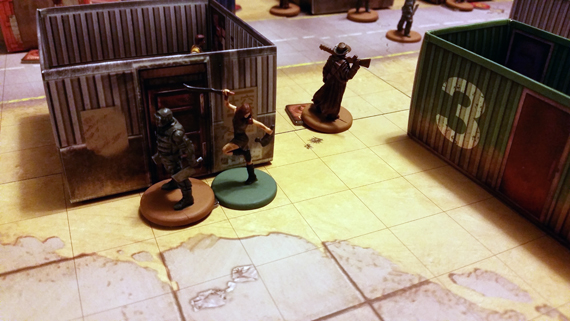
2018 was the year of the skirmish game for us. We spent a lot of time playing 7TV, Doctor Who: Exterminate, and Mythic Battles: Pantheon, and even more time painting miniatures and building terrain for them. On the surface, Firefly Adventures: Brigands and Browncoats looks like another boxed skirmish game, but it really isn't -- at least, not entirely.

Like Firefly: the Game and Doctor Who: Time of the Daleks, Firefly Adventures shows that Gale Force 9 are masters at building engaging games around licensed properties, rather than simply slapping a licensed theme on an otherwise generic game design, and that they have a deep understanding and respect for the material the game is based on.

It's a cooperative game where every player plays a character from the Serenity crew, which should immediately appeal to fans of the television show. The game controls the bad guys using a simple but elegant AI that dictates what they do based on criteria such as where the closest player character is, or in some cases a pre-determined patrol route. This is interesting, but it is the game's two core concepts that really set it apart from other games of this type, and also makes playing it feel like an episode of the show.

The first of these is the idea that player characters switch back and forth between acting casual or acting heroic at various points in the game, sometimes by choice and sometimes not. A casual character can move freely about the board without attracting the attention of the bad guys, making it easier to sneak into buildings and even talk to the non-player characters. However, many actions such as attacking or breaking down doors require characters to act heroic, which attracts the attention of the bad guys, causing them to move and attack any heroic characters they can see. Each state is represented by a separate miniature, one in a casual pose and the other in a more action-packed one.


The other game mechanic that makes this game more interesting and thematic is the turn structure. Rather than just moving in turn, characters' movements are dictated by a time-based system, with different actions taking up specific amounts of time (called "moments" in the game). Each character has a counter that is moved along a track based on what actions they take, and the character at the back always takes the next turn. This is where the strategy and decision making gets really interesting, as you have to weigh the actions you want to take against how far along the time track you will move, and what characters will act before you get another turn.

The game also has a card and dice-based system to govern both breaking into buildings and talking to non-player characters. You draw a card on each attempt that gives you two choices of possible actions to take, some of which might be easier but force you to act heroic and attract the attention of the bad guys.

Game play is scenario driven, with different board setups and win conditions, which really makes it feel more like a role playing game with no game master than a tactical skirmish game. Tactics usually involve sneaking around trying to avoid a fight rather than all-out combat, and the goal is usually to escape the board with an objective instead of just defeating all opponents. There's even a campaign mode where you try to collect as much money and equipment as possible over several games.

One other thing I have to mention is the game's ingenious terrain, a series of small pre-built boxes designed to look like the converted shipping crates that make up so much of the background of the television show. The game box bottom itself is printed to look like a larger building. It's a clever way to introduce 3-D terrain, and also important for a game where staying out of the bad guys' line of sight is often the best strategy.

The only real complaint I have is that the rule book is poorly organized, making looking up rules somewhat difficult during play. As skirmish games go it's fairly simple, but there are always going to be times when you need to refer to the rules.

Rating: 4 (out of 5) A fun, innovative game that feels much more cinematic than most "move and shoot" games, only marred by a poorly organized rule book.

Dragon Ball Z: Kakarot Review (PS4/Steam)

By on 14:48
Written by Alexander O. Cuaycong and Anthony L. Cuaycong


Title: Dragon Ball Z: Kakarot
Developer: CyberConnect2
Publisher: BANDAI NAMCO Entertainment
Genre: Action, RPG
Price: $59.99
Also Available On: Steam, XB1


Dragon Ball has a rich, colorful history. From its humble beginnings as a fun, over-the-top anime series created by manga artist Akira Toriyama in 1984, it has evolved into a giant franchise pervading just about every book and cranny of popular culture. And even casual observers know and understand why: Its deceptively simple story of perseverance, heroism, and strength entertains and resonates among a loyal base of followers with otherwise-disparate tastes. It's filled to the brim with good-natured humor and fun, with epic tales about godly powers and all-too-human frailties. Notwithstanding the countless competition, it has remained a favorite of both the young and young once, and with reason.


The timeless virtue is what Dragon Ball's latest contribution to its vast videogame library realizes and brings to a brand-new audience. Developed for the personal computer and Sony PlayStation 4 by experienced developer CyberConnect2, Dragon Ball Z: Kakarot is an open-world role playing game cum brawler that seeks to translate the best parts of its source material. Providing bite-sized pieces digestible even to gamers with little to no knowledge of the intellectual property, it retells key parts of the manga's main story arcs. And, in so doing, it succeeds in presenting an exciting, adrenaline-fueled experience. It's more than just a tribute to its roots; even as it unabashedly pays homage to its source material, it takes more than enough liberties to keep longtime followers engaged.

In Dragon Ball Z: Kakarot, gamers are thrust into the very heart of the Dragon Ball narrative. They get to play out the most important storybeats of the manga and anime; in the process, they're treated to a 50-hour jaunt that, pun aside, pulls no punches. Fighting is its bread and butter; lightning-fast kicks, knuckle sandwiches, ki strikes, and energy balls line encounters, with characters sparring and exchanging blows in the sky, on the ground, across environments encompassing the franchise's stories past. Really, there's something for everyone to take in, and, unlike other titles with similarly established canon and media, it doesn't blitz through tales or, conversely, spoonfeed all the details.


Instead, Dragon Ball Z: Kakarot introduces plot elements and characters naturally and in keeping with the spirit of its lineage. Even for habitues who know series minutiae by heart, it comes off as surprisingly fresh. And it's comfortable in its own skin: It isn't afraid to cut out parts of the main story arcs that it feels aren't necessary to its purpose, but makes sure that it nails its presentation in any case. In this regard, it's certainly helped in no small measure by spot-on and extremely responsive fighting mechanics that underscore the efforts of CyberConnect2, hitherto noted for its work on the .hack and Naruto IPs.

Indeed, Dragon Ball Z: Kakarot draws from its manga and anime inspirations in conveying the trademark frantic energy that envelops its battles; it manages to translate with utter faithfulness all the signature touches of its source material, bells and whistles intact. Very anime-esque cut-ins and callouts are triggered after special moves, with its distinctive personality — and flair — highlighted by the way characters react to, and communicate with (okay, shout at), one another. Better still, these fights are all translated in a manner that feels so natural, no small feat given its sheer scale.


Those from the outside looking in may find all the fighting, on air and on the surface, bordering on the ridiculous. Characters are able to fly at super speed, display super strength, and use super powers — and in over-the-top fashion to boot. Those steeped in the lore, however, will find the presentation faithful to the series. More importantly, gamers won't have any problems with control and execution; whether on the personal computer or on the PlayStation 4 Pro, feedback is swift and free of lags, and the action presented on screen sans any frame drops. And thanks to an intuitive interface that belies the depth of its gameplay, it manages to blend all its elements together. While making use of an uncomplicated combat system, it nonetheless offers a heady and healthy mix of offense and defense via well-crafted melee and ranged options.

Admittedly, Dragon Ball Z: Kakarot is far from perfect. Given how much depth there is in terms of look, feel, and flow of the story and the fighting mechanics, the open-world RPG elements feel vastly underutilized. At times, these wind up lacking any impact at all, as if simply tacked on to prolong the gameplay and artificially add value to the title. Granted, the optional exploration segments do offer variety by way of side quests and character exposition. Still, they come off as being rather redundant and unrewarding in light of the game's linear narrative.


On the whole, though, Dragon Ball Z: Kakarot exceeds expectations as a brilliant entry to the franchise. Make no mistake; it's not without its quirks. For what it offers, however, it's well worth the time and money of gamers faces with countless alternatives.


THE GOOD:
  • Properly conveys the series' over-the-top energy and frantic combat
  • Tight fighting mechanics combined with responsive controls
THE BAD:
  • RPG/open-world segments feel tacked on
  • Sidequests come off as unrewarding
  • Character progression far from seamless


RATING: 8.5/10